


-
Client
ADOMED is a medical center helping people overcome alcohol and drug addiction.
-
Task:
Improve the website's user experience and increase the number of clients.
-
Services provided:
Web Design, Web Development, SEO Promotion, PPC Management
-
338%
growth in monthly users from Google Search
-
TOP-5
500+ keywords ranked in Google TOP-5
-
4 min 24 sec
average session duration increased from 1 min 15 sec to 4 min 24 sec
-
31.92%
bounce rate reduced from 79.29% to 31.92%
Our work with ADOMED medical center began in 2020. The initial focus was on SEO promotion, web development, design, and later — PPC management.
WEB Development
Web development work was carried out several times over the course of 4 years. An audit at the start of our collaboration revealed that the site had been built in 2015 on the outdated Joomla CMS, using a template with a large number of code errors. The preliminary estimate for fixing the technical issues came to approximately 70–80% of the cost of migrating the site to a new CMS.
After discussing the available options with the client, a decision was made to migrate the site to WordPress CMS, which offers significant advantages over Joomla:
- regular updates including new features, bug fixes, and security improvements;
- better SEO optimization;
- flexibility and scalability, ease of implementing new solutions;
- an intuitive admin interface.
The following work was completed:
- deployed the latest version of WordPress;
- migrated the existing layout to a new custom WordPress theme;
- connected the template layout to the CMS functionality;
- installed the necessary SEO and optimization plugins;
- imported all existing pages, texts, photos, and videos to the new CMS;
- configured 301 redirects for pages with changed URLs;
- tested the site after migration.
In August 2023, the company updated its corporate identity, which made a website redesign necessary in order to:
- align with the medical center’s updated brand identity;
- improve the user experience for site visitors;
- enhance the mobile version of the site.
More details on the design work are covered in the next section.
Leave a request and we’ll contact you shortly
WEB Design
Before the redesign, we also conducted an audit to identify weaknesses in the site’s UX. The findings were as follows:
- most users left the site quickly because they struggled to find the information they needed — reflected in a high bounce rate of 78.49%;
- users had difficulty absorbing information: the average session duration was 1 minute 16 seconds;
- pages contained little useful content — on average, a single user visited only 1.47 pages per session;
- conversion blocks that would allow users to submit a request or call were not visible;
- users struggled to navigate the site due to the absence of intuitive navigation;
- the site failed to build trust due to a minimal number of real photos and videos.
Based on these findings, we identified the need to improve the visual side of the site and set the following goals:
- simplify navigation across the site, service landing pages, and blog;
- structure the information on pages and improve text readability;
- add dedicated conversion blocks allowing users to leave a request or call;
- add real photos of the center and staff to increase user trust;
- update the overall visual style to align with the center’s brand identity.
Header redesign
Adaptation. The previous header with its menu took up too much space — especially noticeable on devices with lower screen resolution. We reduced its size and removed unnecessary elements that distracted users.
Navigation. We redesigned the menu items: previously, users couldn’t visually tell whether a menu item contained additional subcategories.
Homepage redesign
Banner format change. The previous banner was static and understated. We replaced it with a slider format and added the center’s main services so users could immediately navigate to the service they were interested in.
Content structuring. All text was visually divided into separate sections, low-quality photos were replaced with new ones and placed between relevant sections for easier information consumption. Blocks with large amounts of content and photos were converted into sliders.
Navigation improvement. We added a new block featuring the medical center’s most popular services.
Conversion block redesign. We updated the visual design of the conversion blocks so they stand out from other sections while still fitting the overall site style.
Landing page and blog template redesign
Text structuring. We visually divided texts and supplementary information into sections to improve readability.
Navigation improvement. We added breadcrumbs to every page of the site to simplify navigation. We also added a table of contents on each page so users can jump to any section of the text.
Conversion block updates. We designed additional conversion blocks and distributed them evenly between text sections.
Photo content improvement. We added real photos of the center to landing pages, complementing the content and increasing user trust.
FAQ section creation. We added a section with frequently asked questions and answers.
Footer redesign
Added links to messengers so users can get a consultation or send a question from any page on the site.
Added addresses of the center’s locations in different cities.
Results after redesign:
From the start of the design work to the launch of the updated site took 1.5 months. Within just one month we saw the first results:
- users began spending significantly more time on pages: average session duration increased by 363% to 4 min 36 sec;
- thanks to the table of contents on landing pages and the updated menu, users navigated to other pages much more frequently — the bounce rate dropped from 78.49% to 31.92%.


SEO Promotion
Goal: increase the number of clients coming to the site from Google Search.
Over 4 years we carried out a wide range of SEO work — below we’ll cover the most significant initiatives.
Before starting the site migration to the new CMS, we conducted an SEO audit and identified the following weaknesses:
- the site did not represent all services offered by the medical center;
- no segmentation of services on regional landing pages: all services were described on a single page without logical separation;
- a large number of spelling errors in the Ukrainian version of the site;
- heavy predominance of high-frequency (HF) keywords with almost no low-frequency (LF) queries on landing pages;
- no consistent logical structure across site pages — some services were placed under “Blog,” others under “Services”;
- no heading hierarchy on pages;
- low page load speed and non-compliance with Core Web Vitals factors;
- low conversion rate from organic channel — only 1.65%;
- schema.org microdata was not applied to all elements;
- irrelevant META information (page titles and descriptions visible to users in Google).
What we did?
First, we built a new, up-to-date semantic core that covered all existing queries related to the medical center’s services. The old site had 24 keyword clusters for services in Kyiv. After building the new semantic core, we obtained over 30 service clusters — each containing both HF and LF keywords. We also formed approximately 100 clusters for services in different regions of Ukraine and thematic blog articles.
Semantic core collection and content
After building the semantic core, we began segmenting the clusters to create a logical and consistent page structure.
All service clusters in Kyiv were moved from the blog and other categories into the main services section.
All regional services across Ukraine were logically organized into a hierarchy with separate clusters for each region.
On the previous site, all services for a single region were located on one page — making each page’s relevance low for any given query. We split these into individual pages for each region.
Before editing content on the site, we developed unique META information for each page — each containing 1 HF keyword, several LF queries, and the main advantages of the medical center.
The next and most extensive step was editing existing content and writing new content. We:
- reviewed and edited texts on 93 landing pages in two languages;
- updated HF and LF queries (edited existing sections and added new ones);
- wrote new META tags;
- specified correct ALT tags for every image on the site;
- added expert content for service landing pages that were not present in the old version of the site;
- populated FAQ blocks on main service pages;
- added information, job titles, education, and qualifications for new specialists;
- increased the number of certificates and diplomas confirming staff qualifications.
Blog work
Medical facility websites typically attract a high volume of informational traffic. Ukrainian users first search for information about a condition and self-treatment options — and only then seek professional help. For this reason, the Blog — where useful articles are published — plays a key role in SEO promotion for a medical center. We built a dedicated semantic core and developed a content plan for the Blog covering the following topics:
- treatment methods;
- conditions and diseases;
- treatment tips and advice.
Technical site work
In parallel with content and structure work, our technical specialists carried out a comprehensive set of improvements.
Added Person microdata for authors, FAQPage markup for FAQ sections, and BreadcrumbList markup for breadcrumbs on the mobile version.
Fixed heading hierarchy in the code, making it sequential from H1 through H6.
Optimized page load speed and Core Web Vitals scores for both mobile and desktop. After Google released an update introducing new site quality metrics, the site passed immediately.


Conversion blocks
Since one of the site’s main issues was a low conversion rate, we needed to improve the situation and motivate users to take targeted action. To achieve this, we developed several different conversion blocks.
The blocks were implemented using simple shortcodes, then placed on service landing pages and blog articles in the most relevant sections.
Link Building
After completing the main site and content improvement work, we began building the backlink profile by placing content referencing our site on external platforms. Over the course of one year, we increased the number of referring domains by 42%.
Results
Thanks to our team’s comprehensive work over 4 years of collaboration, we achieved the following SEO results:
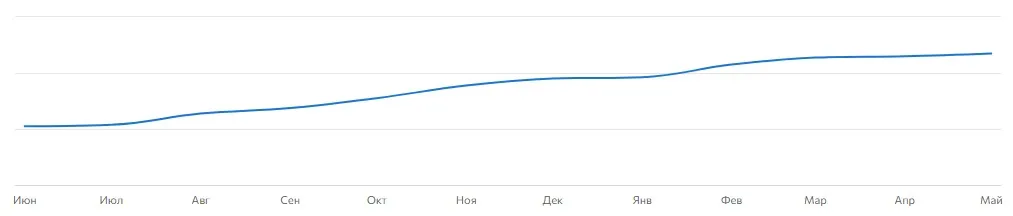
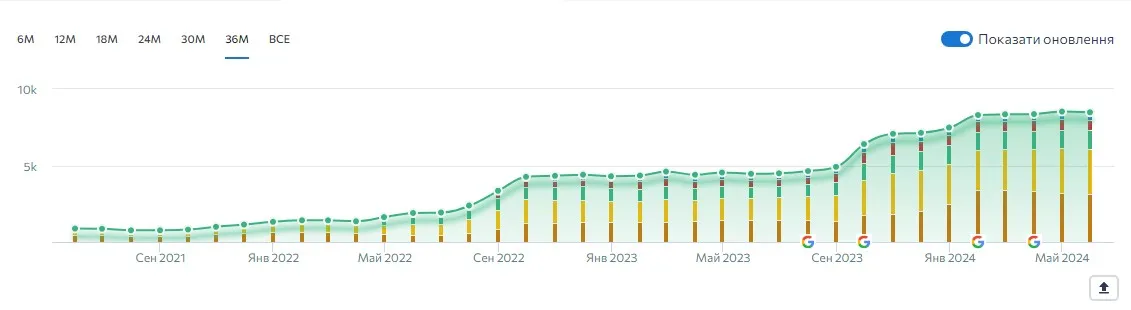
- the average number of users from the organic channel grew from 1,790 to 7,476 — a 338% increase;

- the site now ranks for over 8,000 keywords. Of these, 500+ are in TOP-5: 28 in TOP-1, 123 in TOP-3, 425 in TOP-5. Total keywords in TOP-10: 1,171;
- the conversion rate increased from 1.65% to 5.22%.
We continue to work on improving site content, increasing conversions, and growing the backlink profile.
PPC Management
Goal: increase the number of clients through a new advertising channel.
Our 4 years of collaboration with Adomed medical center showed that 95% of users visit the site from Google Search. When the client decided to open a new branch of the medical center in Kyiv (left bank), we were tasked with attracting new clients through Google Ads.
It’s worth noting that Google Ads policies for the healthcare industry — clinics and rehabilitation centers in particular — are very restrictive in Ukraine. Launching a stable, effective advertising campaign is typically a long-term process.
A competitor audit revealed that:
99% of competitors in this niche use small standalone landing page sites containing the center’s contact information and a link to the main website. This is because Google immediately blocks ad campaigns for sites containing medical terminology.
Due to Google’s restrictions, it became clear that only Google Search campaigns could be used for advertising. We decided against using Display Network (GDN) and Performance Max campaign types, as most of their traffic comes through banner ads — which require compelling visuals to attract users to click. Given Google’s restrictions, we could not use keywords or service descriptions in these formats, making it impossible to communicate the core message of the ad. The resulting traffic would not have been relevant.
Getting started
In two days, our team developed the design for a standalone landing page site. After design approval, the development team completed the layout and published the site on a new domain — also within two days.
In parallel with site development, our PPC specialist completed the following:
- collected all relevant keywords in two languages (Ukrainian and Russian);
- adapted the keywords for use in ads — as 99% of the needed keywords fell under Google’s prohibited categories;
- grouped the adapted keywords into 4 main ad groups, each corresponding to a center service: alcohol coding, alcohol withdrawal, alcohol addiction treatment, and alcohol aversion therapy;
- collected and filtered negative keywords to prevent ads from showing for irrelevant queries.
After completing site development, we began setting up and launching the first ad campaign:
- created a Google Ads account;
- created a Google Search campaign, ad groups, and ads in two languages;
- set up conversion tracking on the site;
- added negative keywords;
- launched the ad campaign.
Campaign optimization and first results
Because healthcare advertising faces significant restrictions from Google — most importantly around keyword usage — all collected keywords had to be used in broad match. When launching with this strategy, collecting the maximum number of negative keywords is critical to prevent ads from reaching users outside the target audience. The most important daily optimization task was therefore adding irrelevant search queries to the negative keyword list.
After two weeks from launch, we received the first results:
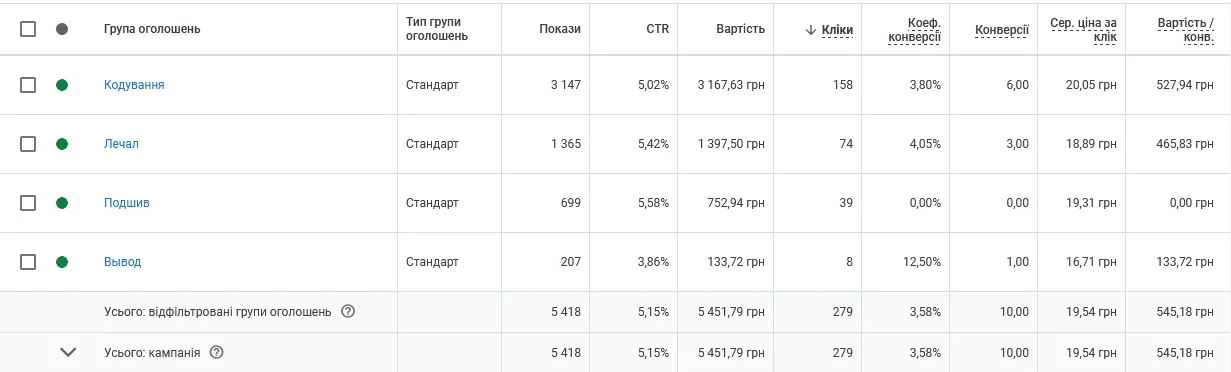
- 10 conversions from ads at a cost of 5,451.79 UAH;
- conversion rate of 3.58%, cost per conversion — 545.18 UAH.
Results after one month
Analyzing the initial results made it clear that we needed to reduce the cost per conversion, increase conversion volume, and scale the campaign — the first two weeks ran on a total budget of 500 UAH/day. The following decisions were made:
- split the campaign into two separate campaigns — one for Ukrainian-language keywords and one for Russian-language queries;
- maximize the content of both campaigns to reduce average CPC and improve ad positions;
- change the bidding strategy from “Maximize clicks” to “Maximize conversions” to get as many conversions as possible for the same budget;
- reduce the number of keywords, keeping only commercial queries and removing all informational and general terms;
- create multiple ads in each group so Google could automatically select the best-performing one.
After implementing these changes, the results after one month were:
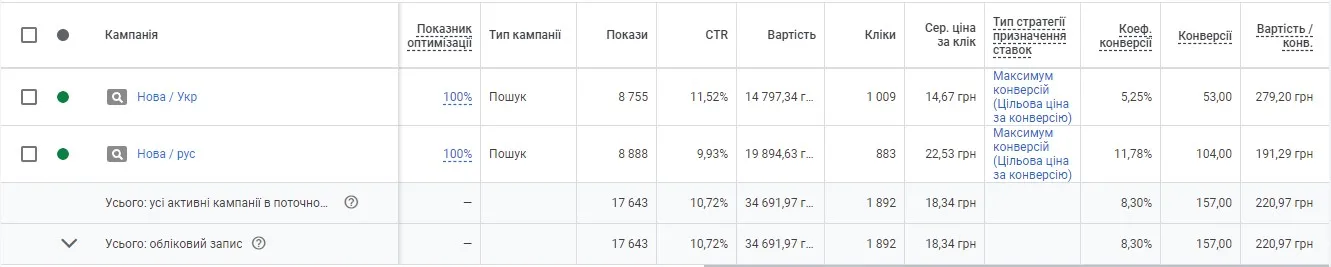
- 157 conversions for 34,691.97 UAH;
- conversion rate increased to 8.3% compared to 3.58%;
- cost per conversion decreased by 246% — from 545.18 UAH to 220.97 UAH.
Overall Results
Summarizing the results across all areas of our work with the client:
- the site became significantly more user-friendly, technically superior, and more attractive to Google;
- traffic from Google Search grew by 338%;
- the site ranks in TOP-10 for 500+ keywords;
- the organic conversion rate grew from 1.65% to 5.22%;
- the newly launched advertising channel now delivers additional monthly traffic with an 8.3% conversion rate.

Contact Alaito Healthcare. We are ready to share the current to illuminate companies in the worldwide market.